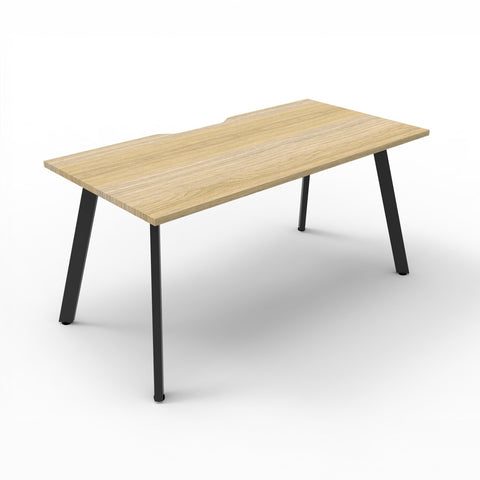
Eternity Leg Workstation
Open plan offices rarely need one desk at a time, they need a system that scales across a team. The Eternity Leg Workstation is built around that requirement, available in PODs of 2, 3, 4 or 5 workstations with straight, corner and back to back configuration options, giving workplace planners a genuinely flexible desking system rather than single desks arranged after the fact.
The splayed leg profile, at 60mm by 30mm, is both a structural and visual choice, giving the workstation a distinct stance while a double support rail adds the strength needed to handle multiple desks joined together as a single POD. It is engineered to hold up under the load and daily use of shared team desking across South Australian workplaces, not just individual desk use.
The tabletop is locally manufactured at 25mm, available in 1200mm, 1500mm, 1800mm and 2100mm sizes, with custom sizes available for teams or floor plans that fall outside standard dimensions. Whether the layout calls for a straight run, a corner configuration, or desks positioned back to back for a shared team pod, the same system adapts to the brief.
Finished in Laminex and Polytec tabletop options with a black or white powdercoat base, and custom finishes available beyond the standard range, the Eternity fits into most office fitout palettes. A 5 year warranty backs the construction.
Features:
- Locally manufactured tabletop, 25mm
- Splayed leg profile, 60mm x 30mm
- Double support rail for added strength
- 5 year warranty
Specifications:
- Sizes: 1200mm, 1500mm, 1800mm and 2100mm
- Custom sizes available
- Configurations: Straight, corner and back to back
- POD sizes: 2, 3, 4 or 5
- Warranty: 5 years
Finishes:
- Tabletop: Laminex and Polytec finishes
- Base: Black or White powdercoat
- Custom finishes available
Common Questions:
How is a POD size chosen for a team?
It comes down to team size and how people work together. Smaller PODs of 2 or 3 suit tighter team groupings, while 4 or 5 suit larger teams wanting to sit together as one connected unit rather than split across separate desking runs.
What is the difference between straight, corner and back to back configurations?
Straight runs desks in a single line, corner allows an L shaped layout for shared or angled work areas, and back to back joins two rows of desks facing each other, common in open plan team pods.
Why does the double support rail matter for a multi desk POD?
Joining several desks together as one POD puts more structural demand on the frame than a single desk, and the double support rail is there to keep the whole configuration stable and rigid rather than relying on the tabletop alone.
Setting up team desking and need a system that scales properly? Talk to Creative Systems about your project.
📍 165 Grote Street, Adelaide SA 5000 📧 sales@creativesystems.net.au 📞 0479 111 451

Start a Conversation
Where to Find Us
Creative Systems
165 Grote Street
Adelaide SA 5000
📧 sales@creativesystems.net.au
📞 0479 111 451
Got a question?
Have a question about this project, or want to discuss something similar for your own space?
Contact Us